

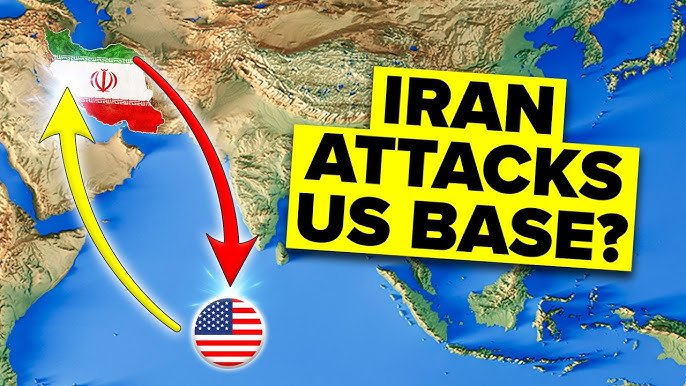
On June 23, 2025, the Islamic Republic of Iran fired a missile attack at U.S. military installations in Qatar and possibly Iraq. Iranian state television reported that this operation, code-named “Annunciation of Victory,” was an incremental reaction to recent U.S. and Israeli attacks on Iranian military and nuclear targets. Intended as a symbolic gesture, not a bid for the high-casualty coup, the strike has yet added a further explosive page to the Iran–Israel–U.S. confrontation. This piece examines the background, implementation, initial consequences, regional reverberations, and broader implications of this strategic escalation.
U.S. and Israeli attacks on Iran
The crisis had earlier started on June 21, 2025, after coordinated air strikes by the U.S. and Israel on Iran’s nuclear facilities, including subterranean facilities at Natanz and Fordow. U.S. President Donald Trump ordered these raids under Operation Midnight Hammer, which destroyed major nuclear facilities while warning of future actions should Iran strike back.
Iran’s response policy
Iran first fired missiles at Israel, and retaliation with civilian casualties followed this. With threats to American bases and even the Strait of Hormuz, tensions shot up sharply. Yet, to prove its strength without prompting a full-scale war, Tehran threatened a more calculated retaliatory operation.
Communicating and preparing
Iranian officials were sending the messages loud and clear. According to state television and official announcements, the imminent attack on the interests of the United States, especially the Al Udeid Air Base in Qatar, was the right response, indicating equal footing with American airstrikes. The nation also passed on pre-warnings diplomatically to both Qatar and Washington, allowing for defensive actions to be taken.
Glad Tidings of Victory operation
- Time and magnitude
The barrage took place at about 19:39 lack Anti Standard Time (16:39appreciate Universal Time) on June 23, and the 14 launched ballistic missiles were a number Iran stated represented the number of U.S. bunker defending bombs previously employed
- Aims and locations
Al Udeid Air Base, Qatar: U.S. CENTCOM headquarters in an ally country, with approximately 11,000 to 10,000 American and coalition forces.
- Interception and impact
Most of the missiles were nullified by a combination of Qatari and U.S.U.S. defenses, w, which included Patriot systems. The reports range from 13 to 14 interceptions with minimal penetration, one of which lightly hit Al Udeid.
- Iranian narrative
Iran called that a devastating and powerful stroke and a successful retaliation that sought to respond to the U.S. aggression on a similar level. By labeling it the “Annunciation of Victory,” Tehran added a psychological and symbolic layer to the strike.
Immediate Fallout
- Regional disruption
In a queue of the assault, Qatar stopped its airspace and gave shelter-in-place procedures to the U.S. troops; others (UAE, Bahrain, Kuwait, Iraq) trailed them
- U.S. and Qatar reaction
Both governments acknowledged the attack but concentrated on defense, highlighting that there were no casualties. President Trump called the attack on Truth Social a weak reaction and positively evaluated the Iranian previous warning, saying that it was a chance for peace
- Political response in the regions
Qatar described the attack as an infringement of sovereignty. Destabilization, as well as a threat to security, was also a concern concern for Bahrain, the UAE, and Saudi Arabia. The swift reassurance by the intercepts certain partners in the Gulf and highlighted the vulnerability of the region’s security mechanisms.
Strategic Implications
- Tehran’s test by calibration in Iran fulfilled its goals twice: it was a response in kind, but it also felt the need to demonstrate its outcomes without the threat of a full-scale war. The risk possibilities were reduced by warning and precise targeting, which has been an intentional strategic position.
- Deterrence Evolutions: The successful employment of ballistic missiles in their attacks on fixed, defended targets challenges the capabilities of existing U.S. and adjacent air defenses. Patriot systems functioned well, but the danger of relying on these shields was made evident by the close call.
- Potential for rapid escalation. Although the strike is symbolic, it is also dangerous: one wrong move, misunderstanding, miscalculation, or other malfunctions (especially intercepts) might lead to a larger war. As Iran and Israel are now on alert, any additional interactions may end up escalating into wider animosities.
- Rifts and opportunities in diplomacy: The event was used by the U.S. to advocate for peace, portraying Iran as acting under duress. The proposal made by President Trump to Iran and Israel of a ceasefire that Qatar may mediate has not proved to be as strong as it can be case suggested by the continued bombardment of that region, which means that more is still required to calm the situation.
- Battlefield dynamics: Change in Old Afghanistan Versus New Battlefield Dynamics. This story introduces a new kind of Middle Eastern conflict: hybrid warfare and strategic ambiguity. Iran is experimenting with diplomatic warning combined with missile salvoes, Israel and the U.S. are taking both airstrikes, as well as intelligence-supported covert actions, and Gulf states are courting dangerous middle ground.
Looking Ahead
- Future moves will enable Iran to continue taking a position to strike back in case of need. The obvious candidates to strike next are the U.S. bases in either Bahrain or the UAE or an innovative method such as cyber or sea operations.
- Threat of Strait of Hormuz Closure. The closure of the Strait of Hormuz, one of the key directions of the world’s oil supply, has been suggested by Tehran as one of the escalation measures. thetimes.co.uk Such a step would present a complete upheaval in the global economy and likely lead to military action.
- Soft power diplomacy, other mediators in the region, such as Qatar and other Gulf states, may reemerge as actual and live ceasefires are implemented. Iran will be compelled to negotiate if it can establish moral and military parity.
- Lessons on future deterrence Countries need to re-evaluate their rotational deployment tactics, air protection layering, early alert techniques, and ability of base activities. The incident prompts a reconsideration of methods to discourage symbolic yet powerful missile communications.
Conclusion
The recent Iranian attack, a code-named Annunciation of Victory on the U.S. bases in the Middle East, reveals how subtle the balance of strategic game in the Middle East is: a show of power without necessarily wanting to bring an uncontrollable world war. Although there was the Interception of missiles and no loss of lives, the attack tears into current assumptions of deterrence, and Iran now includes speed of attack, warning, and proportionality to its calculus of retaliation. The level of tactical intensity poses a new priority in diplomacy, de-intensification, and reflections on the key organization of U.S. positioning in the region. To Iran, the attack is a reaffirmation of national strength and a declaration of equality. It has highlighted a strategic juncture in the minds of Washington and its allies: limiting the number of small sparks that could give rise to a flame in the region.


